Temporal kernel semantics table
Input events and the exact frame each temporal kernel
produces from them. Every expected frame below was worked out by hand from the kernels'
definitions, not by running Frames2Py. The test suite checks the same cases against an
independent per-event reference implementation and against StackedHistogram and
VoxelGrid through both the Accumulator and the Engine, and checks that this page shows
exactly those cases.
Setup and notation
Every case uses a sensor 2 pixels wide and 1 high (sensor_size=(2, 1)), so frames are
(2, bins, 1, 2) and (bins, 1, 2), and bins=3, bin_us=10 unless its row says otherwise:
grid bin k is [10k, 10k + 10) µs.
- Events.
+12is an ON event (p = 1) att = 12µs on pixelx = 0;-12is an OFF event (p = 0).@1puts it on pixelx = 1.@2(x = 2),@5and@0,1(y = 1) are outside the sensor.(p=2)gives anotherp: anyp != 0is ON. - Calls.
|separatesaccumulate()oringest()calls;()is a call with no events;resetcallsreset(). - T is the watermark after the last call: the largest
timestamp among accumulated in-bounds events, or
None. - Frame. Only nonzero pixels are listed; everything else is 0. Values are oldest first:
ON x0: 2 1 1means channel 1 (ON), pixelx = 0,j = 0, 1, 2. AVoxelGridvalue is the float32 nearest the number shown (0.8isnp.float32(0.8);2/3isnp.float32(2 / 3)).
The closing time
Bins are half-open and only completed bins are shown. A frame read at watermark T
shows the bins before T // bin_us; the bin T falls in is still filling and is hidden.
An event at exactly a frame's closing time, (T // bin_us) * bin_us, is therefore in the
hidden bin, not on the frame's last bin or knot. E2VID, E-RAFT and RVT place such an event on
their final knot or bin; Frames2Py follows the half-open convention of DSEC's event slicer
(t_start <= t < t_end). The cases "bins are half-open", "an event on a knot gives it full
weight" and "a bin shows once the watermark passes it" show it.
The worked example, the first row of both tables, drawn on the time axis:
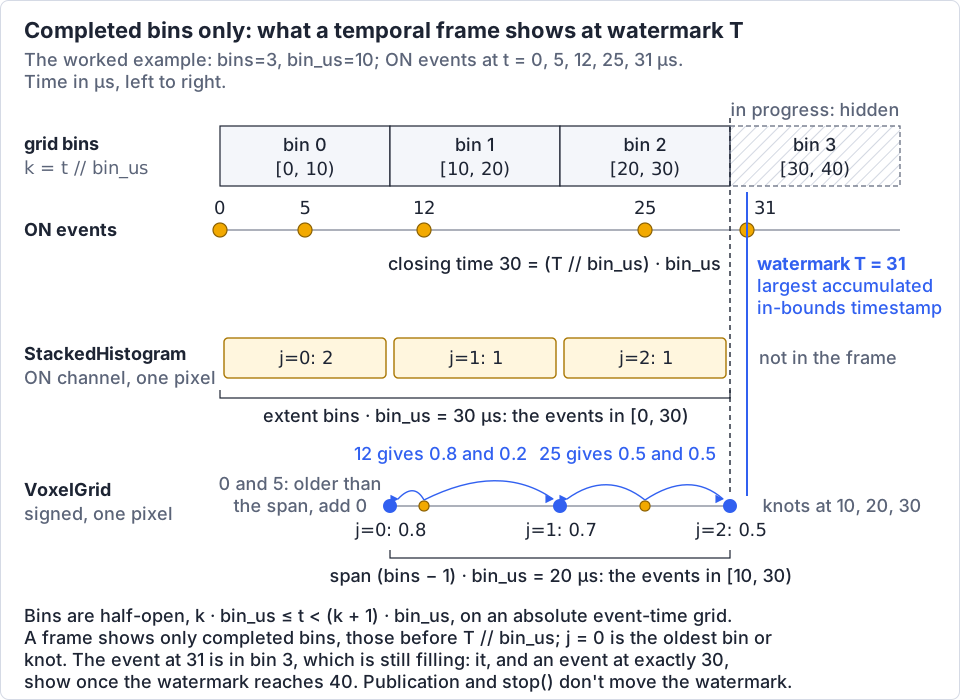
StackedHistogram
StackedHistogram(bins=3, bin_us=10): (2, 3, 1, 2) uint32, channel 0 OFF and 1 ON, j = 0
the oldest bin. The frame covers the 3 completed bins before T's.
| case | bins, bin_us |
calls | T | frame | why |
|---|---|---|---|---|---|
| worked example | 3, 10 | +0 +5 +12 +25 +31 |
31 | ON x0: 2 1 1 |
bins [0, 10), [10, 20), [20, 30) are shown; 31 is in the bin in progress |
| arrival order doesn't matter | 3, 10 | +31 +25 +12 +5 +0 |
31 | ON x0: 2 1 1 |
the watermark is the largest timestamp, not the last event's |
| partition into calls doesn't matter | 3, 10 | +25 +0 | () | +31 +12 | +5 |
31 | ON x0: 2 1 1 |
the same events split into four calls, one empty |
| equal timestamps share a bin | 3, 10 | +15 +15 +15 +30@1 |
30 | ON x0: 0 3 0 |
all three are in [10, 20) |
| bins are half-open | 3, 10 | +9 +10 +19 +20 +29 +30 |
30 | ON x0: 1 2 2 |
10 and 20 open their bins; 30 opens the bin in progress and is hidden |
| polarity is p != 0 | 3, 10 | -5 +5 +5(p=2) +5(p=255) +30@1 |
30 | OFF x0: 1 0 0; ON x0: 3 0 0 |
every p != 0 is ON; no p value reaches the other pixel |
| out-of-bounds events don't move the watermark | 3, 10 | +5 +12 +1000@2 +1000@0,1 |
12 | ON x0: 0 0 1 |
T = 12 shows bins -2, -1 and 0; bins before t = 0 are empty |
| no in-bounds event | 3, 10 | () | +7@5 |
None | all 0 | no watermark yet, so every value is 0 |
| empty window | 3, 10 | +5 +100 |
100 | all 0 | T = 100 shows bins 7, 8, 9: 5 is older and 100 is in progress |
| the in-progress bin is hidden | 3, 10 | +21 +25 |
25 | all 0 | T = 25 shows bins -1, 0, 1; [20, 30) is partly filled and not shown |
| a bin shows once the watermark passes it | 3, 10 | +21 +25 | +30@1 |
30 | ON x0: 0 0 2 |
the event at 30 completes [20, 30) |
| late event inside the frame counts | 3, 10 | +35 +3 |
35 | ON x0: 1 0 0 |
3 arrives after 35 and is still in a shown bin |
| late event older than the frame doesn't | 3, 10 | +55 +12 |
55 | all 0 | T = 55 shows bins 2, 3, 4; 12 is older |
| reset | 3, 10 | +5 +15 +35 | reset | +100 +112 +125 |
125 | ON x0: 0 1 1 |
after the reset only 100, 112 and 125 exist; T = 125 shows bins 9, 10, 11 |
| bins=1 | 1, 10 | +3 +14 |
14 | ON x0: 1 |
bins=1 shows only the last completed bin |
VoxelGrid
VoxelGrid(bins=3, bin_us=10): (3, 1, 2) float32, knot j = 0 the oldest. With T in bin
k_T, the knots are at (k_T - 2) * 10, (k_T - 1) * 10 and k_T * 10, and the frame
covers the 2 completed bins between the first and last knots. An event at t = q * 10 + r
in that span adds (10 - r) / 10 to the knot at q * 10 and r / 10 to the next, signed
+ for ON and - for OFF.
| case | bins, bin_us |
calls | T | frame | why |
|---|---|---|---|---|---|
| worked example | 3, 10 | +0 +5 +12 +25 +31 |
31 | x0: 0.8 0.7 0.5 |
knots at 10, 20, 30; 12 gives 0.8 and 0.2, 25 gives 0.5 and 0.5; 0 and 5 are older than the span, 31 is in the bin in progress |
| arrival order doesn't matter | 3, 10 | +31 +25 +12 +5 +0 |
31 | x0: 0.8 0.7 0.5 |
as above, in reverse order |
| partition into calls doesn't matter | 3, 10 | +25 +0 | () | +31 +12 | +5 |
31 | x0: 0.8 0.7 0.5 |
the same events split into four calls, one empty |
| equal timestamps | 3, 10 | +12 +12 +12 +30@1 |
30 | x0: 2.4 0.6 0 |
each event at 12 gives 0.8 and 0.2 |
| an event on a knot gives it full weight | 3, 10 | +10 +20 +30 |
30 | x0: 1 1 0 |
30 is on the last knot's time but in the bin in progress, so it is hidden |
| polarity is signed by p != 0, and cancels exactly | 3, 10 | -15 +15(p=2) +12(p=255)@1 +30@1 |
30 | x1: 0.8 0.2 0 |
at x = 0, -0.5 -0.5 and +0.5 +0.5 cancel to exact zeros |
| out-of-bounds events don't move the watermark | 3, 10 | +5 +12 +1000@2 |
12 | x0: 0 0.5 0.5 |
T = 12: knots at -10, 0, 10, span [-10, 10); 5 gives 0.5 and 0.5 |
| no in-bounds event | 3, 10 | () | +7@5 |
None | all 0 | no watermark yet, so every value is 0 |
| empty window | 3, 10 | +5 +100 |
100 | all 0 | knots at 80, 90, 100: 5 is older and 100 is in progress |
| the in-progress bin is hidden | 3, 10 | +21 +25 |
25 | all 0 | T = 25: knots at 0, 10, 20, span [0, 20) |
| late event inside the span counts | 3, 10 | +35 +12 |
35 | x0: 0.8 0.2 0 |
12 arrives after 35 and is inside the span [10, 30) |
| late event older than the span doesn't | 3, 10 | +35 +3 |
35 | all 0 | 3 is before the span [10, 30) |
| reset | 3, 10 | +5 +15 +35 | reset | +101 +115 +125 |
125 | x0: 0.9 0.6 0.5 |
T = 125: knots at 100, 110, 120, span [100, 120); 101 gives 0.9 and 0.1, 115 gives 0.5 and 0.5 |
| two knots, rounding | 2, 3 | +4 +6 |
6 | x0: 2/3 1/3 |
knots at 3 and 6, span [3, 6): 4 gives 2/3 and 1/3, each rounded to float32 |
windows(), which yields frames at chosen event times, has hand-computed cases of its own
in the test suite; its semantics are under
Frames in event time.